
Business Analyst vs Systems Analyst: Key Differences Explained
Understanding the difference between a Business Analyst (BA) and a Systems Analyst (SA) is critical to the success of IT projects and digital transformation initiatives. While these roles often collaborate closely, they have fundamentally different responsibilities, goals, and ways of thinking. Clear role definition ensures alignment, avoids duplicated effort, and improves project outcomes. In this article, we explore each role in detail, highlight their unique contributions, and explain how they work together to deliver effective business solutions.
Business Analyst (BA): The Voice of the Business
A Business Analyst is the link between the business and the technology. Their role is grounded in understanding business needs, identifying process inefficiencies, and ensuring any proposed changes lead to tangible business outcomes. The BA is concerned with the “what” and “why” of a solution—what does the business want to achieve, and why does it matter?
Unlike technical roles, the BA typically works closely with non-technical stakeholders: department managers, front-line users, product owners, and executive sponsors. They spend time embedded with business teams, observing workflows, identifying pain points, and gathering input from those who will ultimately use or be affected by a change.
BAs play a strategic role in defining the current and future states of business operations. They document “as-is” processes, highlight inefficiencies or gaps, and propose “to-be” process designs that align with broader organisational goals. This may include process maps, business rules, and stakeholder engagement plans.
But the BA’s responsibilities go beyond documentation. They’re actively involved in stakeholder management and organisational readiness. They often serve as the liaison to the change management function, assisting in the creation of internal and external communications. When a system or process changes, the BA supports the roll-out through training material development, updates to Standard Operating Procedures (SOPs), and coordination of user acceptance testing.
BAs are also responsible for driving business case development. They pitch new initiatives to senior responsible officers (SROs) and executive stakeholders, ensuring buy-in for ideas that may impact budgets, workforce behaviour, or long-standing practices. They validate that the proposed solutions will genuinely solve the problems that matter to users and the organisation.
A key strength of a good BA is curiosity and research. They benchmark industry best practices, explore what similar organisations are doing, and propose forward-thinking approaches tailored to their business’s needs. Ultimately, their work ensures that the solution makes business sense—regardless of how it’s technically implemented.
Systems Analyst (SA): The Designer of the Technical Solution
A Systems Analyst is responsible for translating business requirements into system specifications. They work within the IT function, focusing on how the system should behave to meet the objectives set by the BA and the business. If the BA is concerned with what needs to happen, the SA is focused on how to make it happen—within technical, architectural, and policy constraints.
SAs examine requirements through the lens of system feasibility. They break down each process and assess how it can be executed using software systems, automation, integration, or infrastructure components. This includes designing system interactions—between users, APIs, databases, automated jobs, and other digital components.
Whereas BAs focus on the human and organisational aspects, SAs focus on the system’s performance, integrity, and maintainability. They create detailed specifications that guide developers and engineers, such as system diagrams, process flows, technical user stories, and rules expressed in pseudo-code or structured English. Their outputs help both technical and non-technical stakeholders understand how the system will work.
A critical part of the SA role is working within constraints. They must adhere to enterprise design patterns, existing system frameworks, licensing agreements, cyber security standards, and infrastructure capabilities. When a business requirement conflicts with a system limitation, the SA collaborates with the BA to resolve the issue—either by proposing an alternative solution, recommending architectural changes, or escalating the discussion to enterprise architects.
Systems Analysts are also concerned with the longevity and cohesion of the technical environment. They aim to design solutions that are secure, scalable, and maintainable. They understand that introducing a system that deviates from established design patterns may lead to future technical debt. Therefore, they advocate for consistency and best practices even when business pressure may lean toward a quick fix.
While they may not engage directly with end users, SAs play a critical role in ensuring that system design supports user experience indirectly—by ensuring that systems are stable, secure, and perform reliably. Their success is measured not only by whether a system meets its functional goals, but also by how well it integrates with existing infrastructure and whether it can scale with the organisation’s growth.
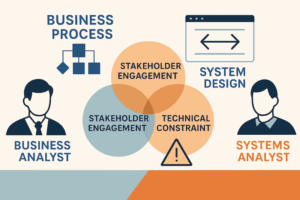
“A BA without an SA may deliver ideas that can’t be built. An SA without a BA may build a system no one wants. Together, they turn vision into value.”
Where Business Analysts and Systems Analysts Overlap
Although the Business Analyst and Systems Analyst roles are distinct, they must collaborate closely to ensure project success. Their collaboration is the bridge between business value and technical feasibility.
The BA initiates the process by defining what the business wants to achieve. The SA then examines how those goals can be implemented technically. Together, they validate assumptions, refine scope, and manage trade-offs between what is desirable and what is possible.
One key area of collaboration is in requirements definition. BAs translate user goals and stakeholder priorities into business requirements. SAs interpret those into technical specifications, defining how data will flow, what system interactions are needed, and what constraints must be accounted for. When friction arises—such as a business requirement that conflicts with a system limitation—the BA and SA work together to find the best path forward, either through compromise or escalation to architecture and governance bodies.
They also both create process models, but with different perspectives. The BA models how a business process currently operates and how it should operate in the future from a business point of view. The SA models how systems will behave to support that new process, including data flows, user interactions, and background processes.
In areas like testing, change management, and deployment, the BA focuses on the people: who needs to be trained, what communication is needed, and how change will be accepted. The SA focuses on system integrity, ensuring that the deployed solution won’t break existing services or violate security policies.
Their combined input ensures that business needs are met without compromising system design, and that technical solutions are implemented with the business context in mind. Successful collaboration between BAs and SAs prevents misalignment, scope creep, technical debt, and poor user experience.
Comparison Table: Business Analyst vs Systems Analyst
| Category | Business Analyst (BA) | Systems Analyst (SA) |
|---|---|---|
| Primary Focus | Business needs, user experience, stakeholder value | System design, technical feasibility, architecture integrity |
| Department Alignment | Business operations, transformation, change management | IT department, solution architecture, development |
| Deliverables | BRDs, SOPs, process maps, training plans, stakeholder presentations | System specifications, pseudo-code, technical diagrams, data models |
| Perspective | People- and process-oriented | System- and performance-oriented |
| Stakeholder Engagement | Works directly with end users, SROs, change and training teams | Works with developers, engineers, and enterprise architects |
| System Knowledge | High-level understanding of technology and its user impact | Deep understanding of system behavior, limitations, and integrations |
| Constraints | Driven by business goals and outcomes | Driven by policies, standards, architecture, and infrastructure |
| Process Modelling | Business logic: “as-is” and “to-be” process diagrams | System logic: technical workflows and system interactions |
Conclusion
Understanding the difference between a Business Analyst and a Systems Analyst is essential for any organisation undertaking change. BAs bring clarity to business needs, stakeholder expectations, and user impact. SAs bring discipline to technical design, security, and performance. Each role supports the other, ensuring that the right solution is built, and that it is built the right way.
While their focus differs—people and process versus systems and performance—their collaboration is where successful digital transformation happens. Projects succeed not because of one role or the other, but because BAs and SAs work together, translating vision into working systems.
Recent Articles
- August 1, 2025Business Analysis
- July 20, 2025Software Design
- January 15, 2022Business Analysis